


My first AMA New York event — “The Return to Real: IRL in the Age of AI,” August 19, 90 Park Avenue
I got there at 5:50 p.m. The check-in guys were lovely, handed me a sticker with my name on it, and pointed me in.
And then I stood in a room of about a hundred people, every one of whom was a stranger to me.
It was 20 minutes into the initial networking slot but it felt as though everyone there knew everyone. Members who hadn’t seen each other were reuniting loudly, others were discussing the highlights of their day, while volunteers worked meticulously to set up the stage for the panelists. The energy in the room was unmistakable even before a panelist had spoken a word.
I also felt out of place, and I’d rather say that than pretend otherwise. I’m a B2B product marketer, and this seemed like a room full of consumer brand and advertising folks. Don’t get me wrong, we share the same marketing language and the obsession to connect with customers, but work-wise, our days couldn’t differ more. As I stood there by myself, I wondered if I might have made the wrong call.
But one person interrupted those thoughts. A man who worked in consumer insights introduced himself – a quick intro followed and we casually exchanged info on where we work and what we do. He was warm, and we chatted briefly about whether my company ever needed consumer insights work. It was a small interaction, but it made me feel a little less out of place, and I was grateful for that.
Then I found Nancy, the chapter’s chief of operations, and introduced myself. Thirty seconds later, she was walking me through everything – member benefits, the collegiate chapters, volunteering and how to get involved in mentoring. She encouraged me to talk to as many people as possible. And just like that, I felt a lot more at ease being there.
The Panel
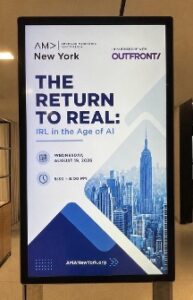 The title made me curious about whether in-person experience is making a comeback in a world saturated with AI. The panelists discussed at length how human connections play a unique role in creating lasting impressions on customers and how brands can leverage AI to be intentional about providing such experiences.
One example, shared by a panelist, stayed with me in particular. She described walking into a perfume store and having such an immersive, in-person experience that she couldn’t stop thinking about it long after she had left the store. Eventually, she ended up purchasing from them online. This is an exceptional example of how physical experience pays off: you might not close a sale right away, but it plants a seed that may lead to a conversion elsewhere. I’ve been thinking about this story ever since, which I suppose proves her point twice.
My Question
When the floor opened up for questions, I asked whether customers have always expected great brand experiences, or if something has changed recently that’s making them return to real-world experiences, and whether digital saturation could be the reason.
The panel addressed that by highlighting why human connection matters in brand experiences, and how it makes people feel valued and builds loyalty. And there’s plenty of research showing that it works. The discussion gave me more to think about, and I kept coming back to the question afterward.
A few members I spoke to after the discussion mentioned COVID and how being deprived of social interaction during that time made in-person experiences feel more valuable. That explanation resonated with me, but I kept wondering whether there might be another factor at play.
It Might Just Be Supply and Demand
The desire for real experience has always been there. What changed might be digital. With manufactured content increasingly filling up our feeds and our attention spans collapsing to 15-second bits, we are growing increasingly selective about our digital diet. If you think about it, we are actively blocking pop-ups, rejecting cookies, and denying data tracking – the very things that help brands reach us, at least most of the time.
So I can’t help but wonder if the expensive in-person avenue has started looking more rational because the cheaper channel isn’t as easy or impactful as it was maybe a couple of years ago. And so suddenly the in-person experience has become a differentiator instead of a baseline.
My Takeaway
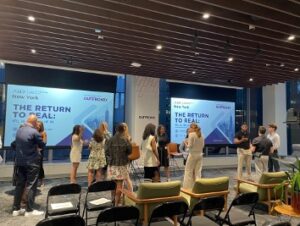
After the panel, a few people came up to tell me it was a good question. One of them, who works in events and community engagement, asked me what made me ask it. I said I was pressure-testing the premise, something I do on a daily basis in my product marketing job as I build positioning & messaging for my products.
I then met a couple of folks with whom I clicked instantly, in a way that can’t be manufactured even with months of LinkedIn exchanges. I’m looking forward to staying in touch.
As I concluded my evening after meeting several accomplished marketers, I realized that this event was a fitting real-life example of what the panelists had been talking about all evening. I walked into a room where I knew no one, and left having made meaningful connections.
So I’m definitely going to the next one. Don’t forget to come say hi.

Supriya Shivananda is a Senior Product Marketing Manager at ADP, where she leads positioning and messaging for a global HCM platform. Previously, she has held product marketing roles at both ad tech and HR tech companies, with her work spanning North America, EMEA, and APAC.
Views are her own. LinkedIn
Click here to view the video and see the collection of photos